

Most leaders are preparing for AI as a productivity upgrade. But the deeper disruption is already underway: AI is breaking the assumptions that careers, organisations, and education were built on.
This episode helps you see the shift clearly — so you don’t optimise your way into irrelevance.
Overview Episode 127
Most AI conversations focus on automation: faster workflows, cheaper output, fewer people.
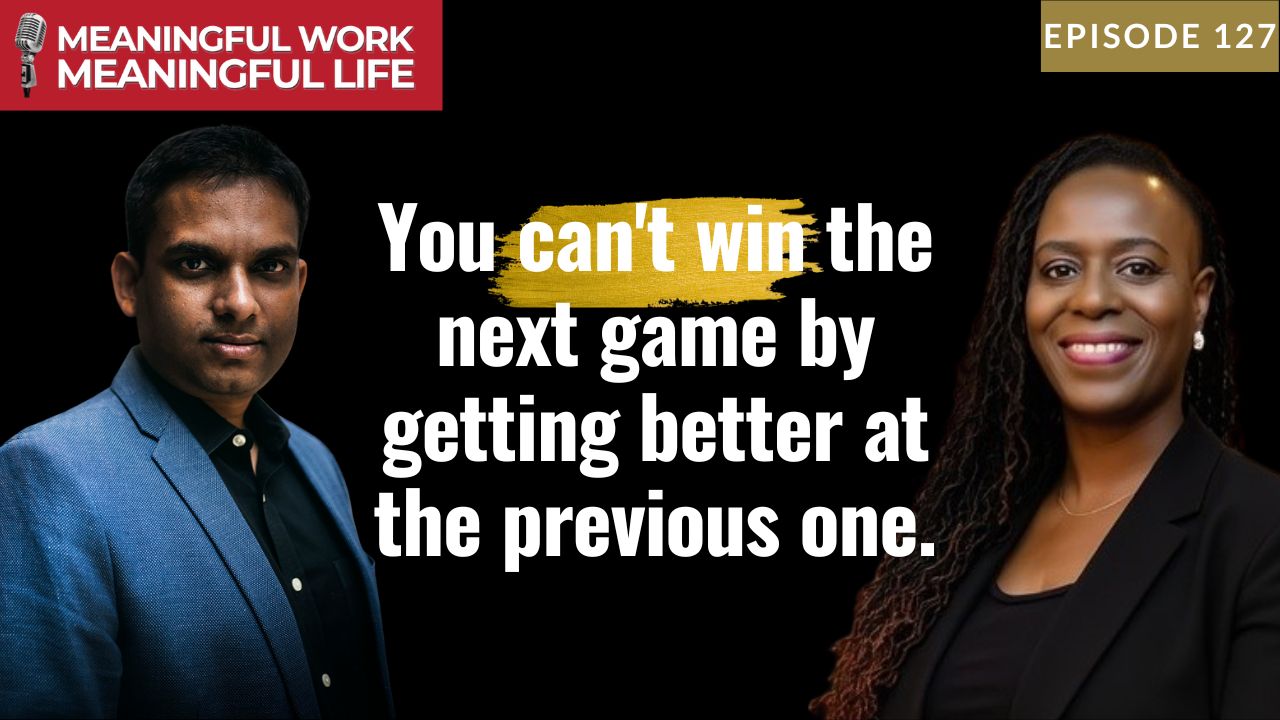
In this episode 127 of Meaningful Work, Meaningful Life, Francine Beleyi speaks with Sangeet Choudary — leading thinker on platforms, ecosystems, and the future of value creation, and author of Reshuffle: Who wins when AI restacks the knowledge economy — to make a deeper argument:
AI is not just changing tasks. It’s changing the assumptions the economy is built on.
And when assumptions collapse, the whole game reorganises.
This is a conversation about agency, dignity, and how leaders and professionals can stay meaningful as the rules of work are rewritten.
Highlights
1) The real disruption is not technological — it’s structural
AI will reshape the world because we will restructure industries and organisations around it. The question isn’t “What can AI do?” but “What game will it force us to play next?”
2) Why companies fail: they get good at the wrong game
Sangeet argues that failure often comes from excellence in an outdated logic — not poor execution. The danger is becoming highly competent in rules that no longer apply.
3) Automation is a first-order effect. Coordination is the second-order shift
The deeper impact of a technology wave is how it changes coordination across systems — not how it replaces a task. AI’s biggest effects will show up in how we organise work, value creation, competition, and entire business models.
4) The shipping container metaphor (and why it matters for AI)
Containers didn’t just automate port labour. They created reliable global logistics by standardising how ships, trucks, and trains worked together — and that reliability reorganised the world economy.
Sangeet’s point: AI’s transformation will come from the wider socio-technical system built around it, not just the intelligence of models.
5) Start by identifying your industry’s hidden assumptions
Industries run on “static truths” that nobody questions until they break. In knowledge economies, one major assumption is that certain knowledge work is scarce and expensive — and AI is collapsing the cost of accessing parts of it.
6) The Shein example: a learning system, not a fashionable brand
Shein didn’t win because it predicted trends better once. It built a system that constantly senses micro-trends, tests small production runs, learns fast, and scales or abandons rapidly.
The difference is that the whole system learns — not just the customer interface.
7) Why incumbents struggle: it’s architecture, not just culture
Incumbents often can’t pivot even if they want to, because they’re constrained by existing investments and operating structures (e.g., manufacturing built for large batches can’t easily switch to micro-batches).
8) Start-ups face a different constraint: the “cash-burning” learning curve
To reach high enough predictive accuracy and system performance, start-ups often need significant funding up front. Before the learning system becomes efficient, it can be expensive to run.
9) Career reinvention: there are no easy answers — but agency matters
Sangeet warns against comforting slogans. The pace and self-improving nature of AI makes this a different kind of labour shock.
His core guidance: agency is becoming more valuable than ever — the ability to anticipate shifts, make bets, and adapt.
10) Reskilling without foresight becomes a hamster wheel
Learning new skills isn’t enough if you don’t understand what the new system will reward. The deeper work is developing a lens for “the new game”.
11) Above the algorithm vs below the algorithm
Those who design, shape, or own the algorithmic system retain agency and value. Those who work below it can lose discretion, pricing power, and stability — even in skilled professions.
12) Education must shift from testing to learning
Education’s biggest problem isn’t content. It’s incentives. If learners are rewarded for passing tests rather than learning how to learn, they’re trained for static worlds — not changing ones.
13) Purpose and leadership: define the real stakeholder
Sangeet argues purpose is contextual. You can’t define it without naming the stakeholder you actually serve — because stakeholders determine incentives, and incentives shape outcomes.
14) A final reframe: be ambitious, not competitive
Competitiveness is playing someone else’s game and trying to beat them. Ambition is defining your own game, getting better at it, and collaborating as needed — a more resilient stance in an AI-shaped world.
Watch episode 127 now.
Subscribe to the Meaningful Work, Meaningful Life Podcast



Purpose Sprint of the Week
Take a moment to reflect on this episode and apply it to your life:
🔸What is one assumption your work or career is built on that may no longer be true?
🔸What is one place where you’re optimising execution instead of relevance?
🔸What is one way you’ve traded agency for comfort or perceived stability?
🔸Map your work honestly. Ask: What do I own? What decides my value? Where do algorithms decide for me?
🔸Then design one move upward toward design, orchestration, or foresight.
Related Resources
🎁Are you curious to discover how closely you’re living your purpose?
Take the free Ikigai Quiz and get a personalised roadmap to deepen flow, energy, and impact.
Connect with the guest, Sangeet Paul Choudhary
- Substack: https://platforms.substack.com/
- LinkedIn: https://www.linkedin.com/in/sangeetpaul/
- Book: Reshuffle: Who Wins when AI Restacks the Knowledge Economy
Connect with Francine Beleyi, the host of the show
- Website: francinebeleyi.com
- LinkedIn: Linkedin.com/in/francinebeleyi
- Instagram: @FrancineBeleyi
Help Me Share this Podcast with Many More People
Use one the buttons below to share with friends and colleagues.